Authority Builder · The book
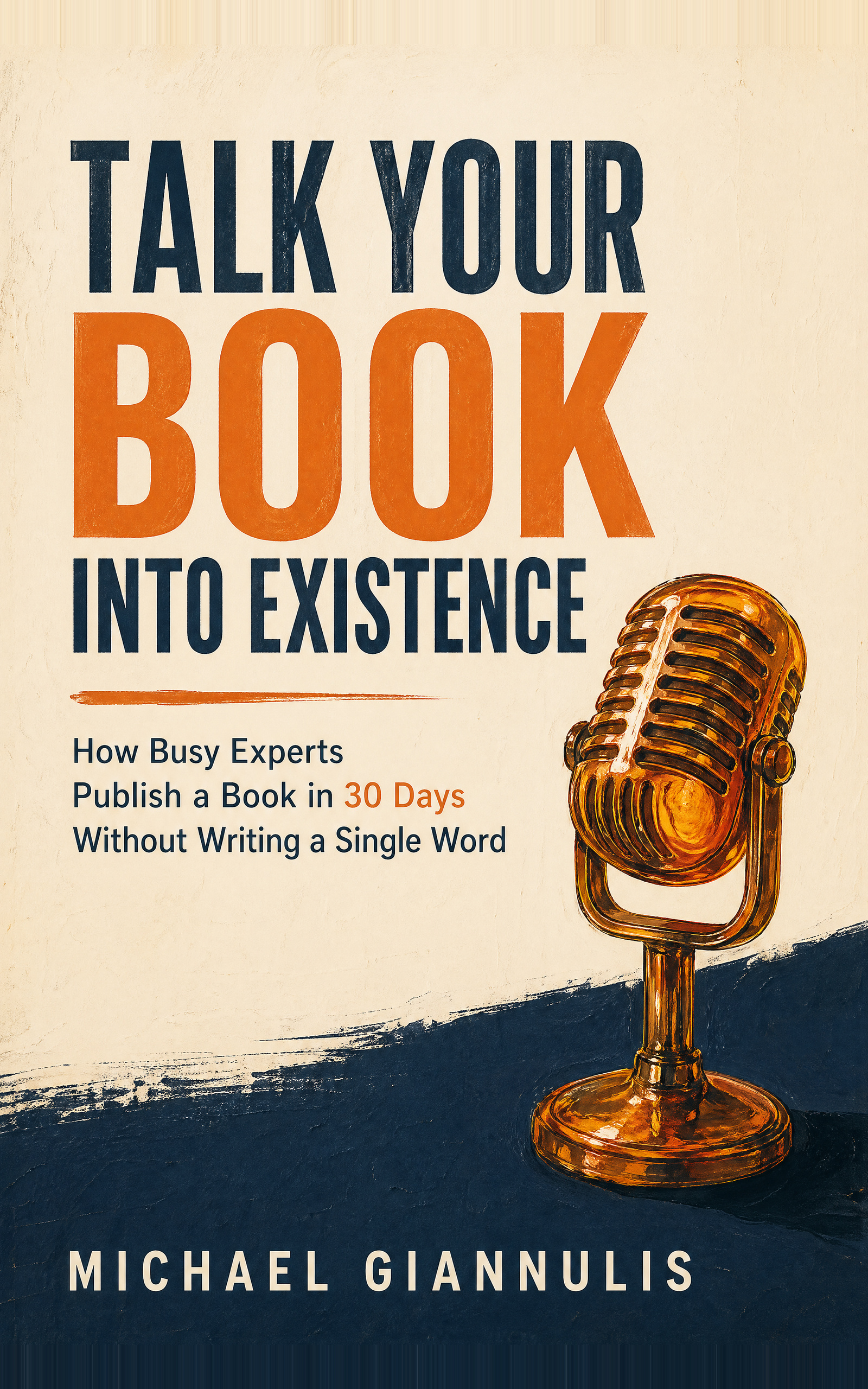
Talk Your Book Into Existence
How Busy Experts Publish a Book in 30 Days Without Writing a Single Word
More than 18,000 business books are published in the United States every year. Most sell fewer than 250 copies, and yet many of those authors still see their fees rise, keynote invitations arrive, and their name land on buyers' shortlists instead of price-comparison spreadsheets. That is the Authority Gap, and a book is the strongest single instrument for closing it.
Talk Your Book Into Existence is for busy experts who already know their material and have been promising themselves a book for years. The bottleneck is not ideas or discipline. It is extraction. Michael Giannulis introduces an interview-based system that captures your voice, organizes your expertise, and moves you from first conversation to published author in 30 days, without writing a single word.
This is not a book about writing. It is a book about converting what you already know into the authority asset your business has been missing. If you bill $300 to $1,500 an hour and the standard "sit down and start writing" advice has never worked for you, this is the system built for you.
The central idea
The bottleneck preventing experts from publishing is not ideas but extraction. Interview-based AI systems solve this by capturing voice and knowledge through conversation, then writing the book in the author's authentic voice.
Audiobook sample: read by the author
Hear the opening
Press play to listen to a sample.
Look inside
Read the opening pages
There's a number I want to start with, because it stopped me in my tracks the first time I really sat with it.
By some industry estimates, more than 18,000 business books are published in the United States each year. Of those, the vast majority sell fewer than 250 copies.
Sit with that for a second. Two hundred fifty copies. Less than half a typical conference attendance. Most authors of business books never sell more than the people who would naturally show up to a single keynote they gave.
Now most people read that statistic and think writing a book is a waste of time. They're wrong.
Here is the right conclusion. 18,000 business books were published. Most of them didn't sell. And yet many of the people who published them saw their professional lives change anyway.
Let me show you what I mean.
I have spent 20 years in direct response marketing. I have personally written copy for or worked alongside hundreds of consultants, coaches, attorneys, financial planners, real estate professionals, and senior experts at firms. I have a very specific data set in my head. I can compare the experts who published books against the experts who didn't. Even books that sold poorly. Even books that weren't particularly good.
The gap isn't subtle. It's not even close.
The published expert tends to raise their fees within twelve months. The non-published expert often holds the same rate for years. The published expert is more likely to get invited to keynote conferences for $10,000 to $50,000 a talk. The non-published expert speaks for free at chamber of commerce events. The published expert is referenced in podcast episodes, magazine articles, and competitive bids by name. The non-published expert gets compared on price.
Same expertise. Same years of experience. Same client outcomes.
Different category in the buyer's mind.
That's what I call the Authority Gap. And it's the most expensive gap you can have in a service business, because it's invisible from the inside.
Most experts assume those two words mean the same thing. They don't.
Expertise is what you know. Authority is what other people know about you.
You can have a tremendous amount of one without much of the other. I have met financial planners who are objectively better than the famous ones on television. I have met attorneys who are sharper than the ones with book deals. I have met coaches who get better client results than the ones with thousand-person email lists. None of those people make the kind of money the famous ones make. The reason isn't skill. The reason is authority.
The unfair part of the system is that authority compounds. The financial planner with a book gets invited to the conference, where she gets the podcast invitations, where she meets the journalist who quotes her, where the next book deal comes from, where the fees triple. Each rung lifts the next one. The financial planner without a book stays inside her client list, working hard, charging the same rate she charged five years ago, watching the famous one collect what should have been hers.
I'm not telling you this to be cynical. I'm telling you so you stop pretending that great work alone produces great results. It doesn't. Great work plus communicated authority produces great results. The book is the strongest single instrument for converting expertise into communicated authority that exists in the modern professional services market.
That's a sentence worth reading twice.
Now here is something most people get wrong about books. They assume the value of a book comes from people reading it.
It doesn't.
Most prospects who decide to hire you because of your book never finished it. Most never read past the introduction. A surprising number never even bought a copy. They saw it on Amazon. They glanced at the cover. They scanned the table of contents. They read three reviews. They decided this person is the real authority in the category. The whole evaluation took about 90 seconds.
That's the function of a book. The book is a credentialing device. It works the same way a degree from a top law school works, or a medical license, or a CFA designation. The reader uses the existence of the credential as a shortcut for trust. They're saying, in effect, "the gatekeepers of this category have validated this person, so I don't have to."
Here is the funny part. Nobody is actually a gatekeeper for self-published business books. There are no gatekeepers. Anybody can publish a book. The reader knows this on some level. And yet the trust signal still works. The book doesn't have to be brilliant to do its job. It just has to exist, look professional, and signal that you have organized your thinking enough to put it on paper.
Once that signal is set, five things start to happen in your business. We'll cover those five things in detail in the next chapter. For now, just understand the basic shape of what a book does.
A book changes how you're perceived before the conversation even begins. That's what you're buying. That's what you've been missing.
I want to walk you through some numbers now, because most experts have never done this calculation, and once they do it, the conversation about whether to write a book ends very quickly.
Let us say you're a consultant who currently charges $400 an hour. Conservative for a senior expert. You bill 1,000 hours a year. Your annual revenue from your own time is $400,000.
You've been thinking about writing a book for five years.
Now run a different scenario. In an alternate version of the past five years, you wrote the book three years ago. You raised your rates from $400 to $600 an hour 18 months after publication. Conservative again. Many of the published experts I have observed raise more aggressively than that, but I want this math to feel reasonable, not aspirational.
In that alternate version, you have collected an...
That is the end of the free preview
Get the full chapter free by email, or get your copy today.
Enter your email to get the full chapter as a PDF.
Your place is saved if you come back later.
Inside the book
Chapter by chapter
01 The Authority Gap +
The Authority Gap: Defines the difference between expertise and authority, explains why the gap is expensive for service professionals, and establishes the book as the strongest tool for closing it.
02 The Five Revenue Mechanisms of a Published Book +
The Five Revenue Mechanisms: Maps the five concrete ways a published book generates revenue for consultants and experts, from fee support to inbound leads to keynote invitations.
03 The Five Problems That Keep Experts Unpublished +
The Five Problems That Keep Experts Unpublished: Diagnoses the structural reasons high-billing professionals never finish a book, making clear that the obstacle is extraction, not discipline.
04 The Four Failed Paths +
The Four Failed Paths: Examines why common approaches like ghostwriters and writing retreats fail to solve the real problem, and what to look for in a method that actually works.
05 The Inflection That Changed Everything +
The Inflection That Changed Everything: Traces the development of the interview-based AI system and why conversational capture is the right solution for this specific audience.
06 Voice First, Everything Else Second +
Voice First, Everything Else Second: Explains why preserving the author's authentic voice is the non-negotiable foundation of the entire method, and how the system protects it.
07 Find Your Signature System +
Find Your Unique Mechanism: Guides the reader through identifying their signature system, the specific framework or process that will form the intellectual core of their book.
08 Choose Your Book Type +
Choose Your Book Type: Helps the reader select the right book format for their authority goals, audience, and business model before any content is created.
09 Talk Your Book Into Existence +
Talk Your Book Into Existence: The operational core of the method, walking through the structured interview process that converts conversation into a publishable manuscript.
10 Structure That Holds +
Structure That Holds: Covers how to organize the captured material into a coherent, reader-ready structure that supports the author's positioning.
11 From Manuscript to Marketplace +
From Manuscript to Marketplace: Guides the reader through the final steps from edited manuscript to a professionally published book available to buyers.
12 Your First 90 Days as a Published Author +
Your First 90 Days as a Published Author: A practical post-publication plan for turning a new book into speaking invitations, elevated fees, and inbound business.
13 One Page to the Reader +
One Page to the Reader: A direct, personal closing note that distills the book's core argument and sends the reader forward with a clear next action.
What you'll take away
A working system, not just ideas
Identify the Authority Gap that is costing you fees and opportunities right now
Understand the five revenue mechanisms a published book unlocks for service professionals
Diagnose exactly which of the five problems has kept you unpublished
Avoid the four failed paths most experts waste time and money on first
Use the interview-based system to capture your voice and produce your manuscript in 30 days
Execute your first 90 days as a published author to turn the book into inbound business
The framework
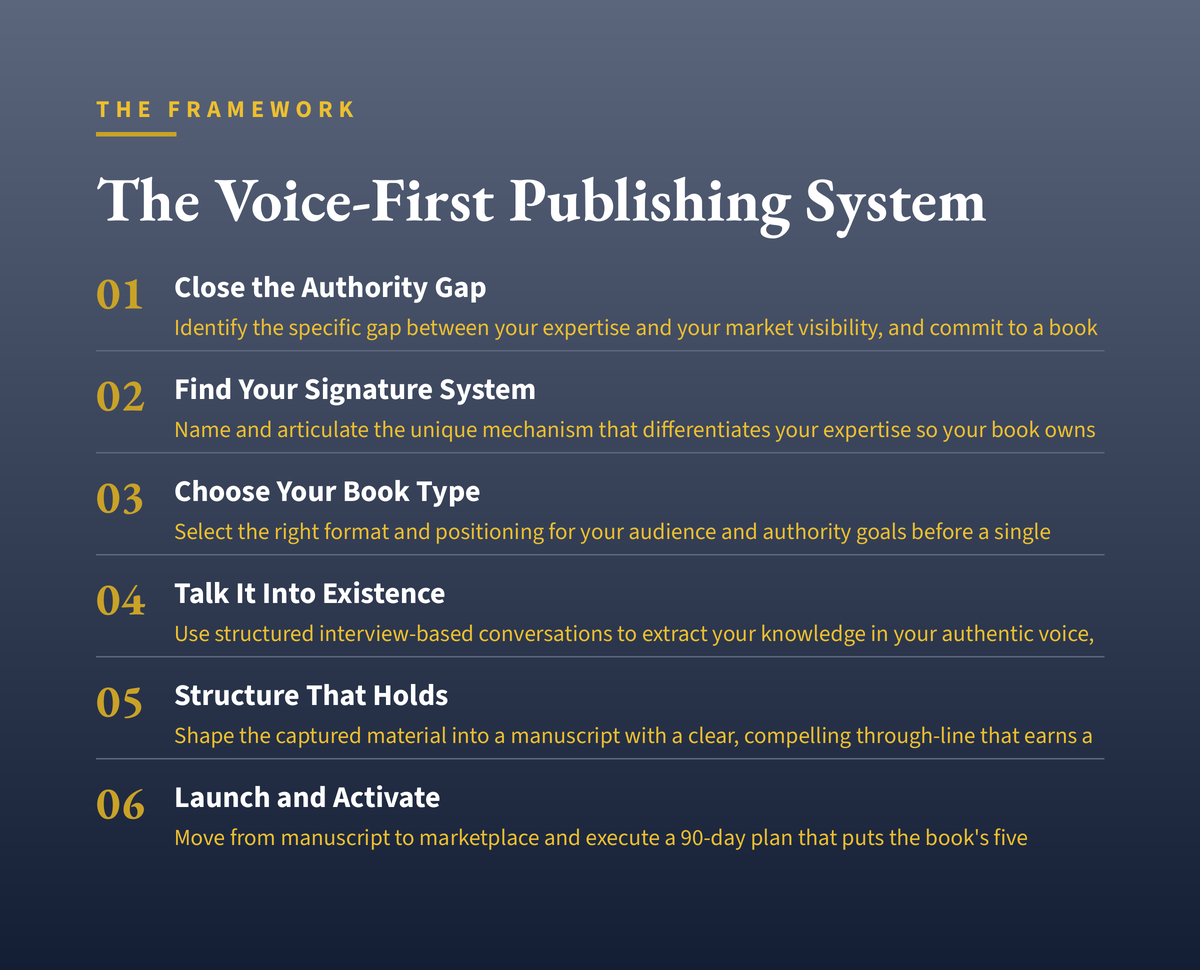
The Talk Your Book Into Existence Method
Ask the book
Questions this book answers
Why haven't I published my book yet, even though I have the ideas?+
The problem is extraction, not ideas. Most experts carry years of hard-won knowledge but have no reliable way to get it out of their heads and into a manuscript. The standard advice, 1,000 words a day, 500 hours at a keyboard, was never designed for someone who bills $300 to $1,500 an hour. The obstacle is structural, not a character flaw.
Chapter 3
What does a published book actually do for my fees and my business?+
The book names five concrete revenue mechanisms a published book unlocks for service professionals: fee support, inbound leads, keynote invitations, shortlist positioning, and category authority. Many authors see their fees rise and speaking invitations arrive even when their book sells fewer than 250 copies, because the authority it signals matters more than the sales volume.
Chapter 2
What is the Authority Gap and why does it cost me money?+
Expertise is what you know. Authority is what other people know about you. The Authority Gap is the space between those two things, and for service professionals it is expensive. Peers with the same skill set but a published book get the call first, hold pricing power, and are rarely asked to justify their fees. A book is the strongest single instrument for closing that gap.
Chapter 1
How does the interview-based system actually work?+
The method captures your voice and expertise through structured conversation rather than requiring you to write. An interview process draws out your knowledge, organizes it, and produces a manuscript in your authentic voice. The system is designed so that every step, from first conversation to published book, can be completed in 30 days without writing a single word.
Chapter 9
I have tried ghostwriters and writing retreats before. Why did those fail?+
Each of those paths fails for the same underlying reason: they do not solve the extraction problem on the expert's terms. Ghostwriters require extensive briefing time and often produce a voice that is not yours. Writing retreats ask you to produce output on a schedule that does not match how expertise actually lives in your head. The four failed paths share a structural flaw the interview-based method is built to correct.
Chapter 4
What should I do in the first 90 days after my book is published?+
The first 90 days are a specific execution window, not a waiting period. The book outlines a practical post-publication plan for converting a new book into speaking invitations, elevated fee conversations, and inbound business. Authority compounds when it is activated deliberately in those first three months rather than left to accumulate on its own.
Chapter 12
Prefer to listen? Hear the ideas behind the book on Talk Your Book Into Existence →
I would rather lose a sale than overpromise.